Incident 1: the slewing-crane padeye
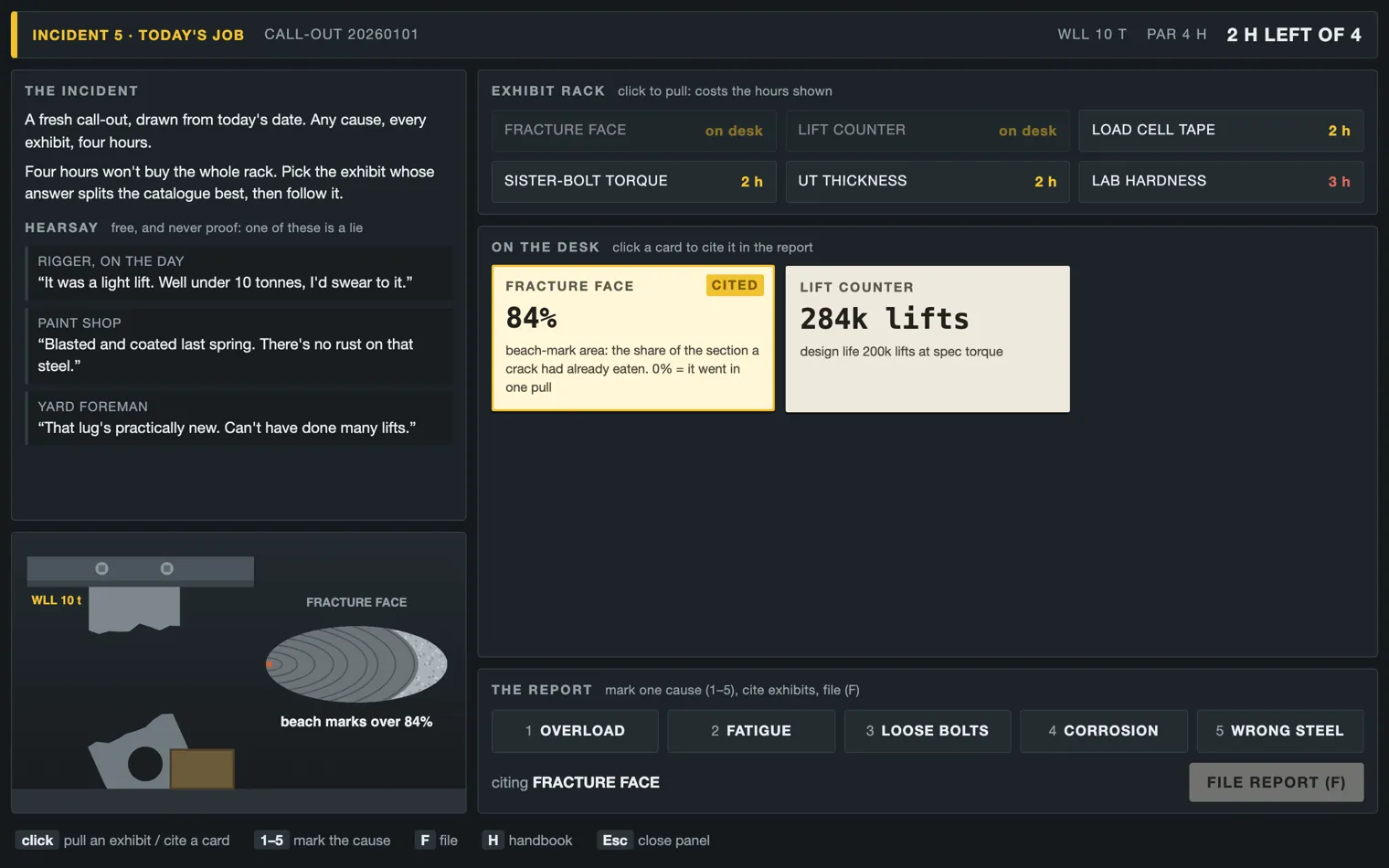
This is the real first file, on the game's own code. Tap an exhibit to pull it (each one costs in-game hours off the insurer's clock). Then tap a card to cite it, mark a cause, and file.
Try this: file any cause you like, citing only the fracture face. If it's right, the card names every cause your proof still leaves open. If it's wrong, the card won't tell you what is.
Five causes, four rules. You buy the evidence.
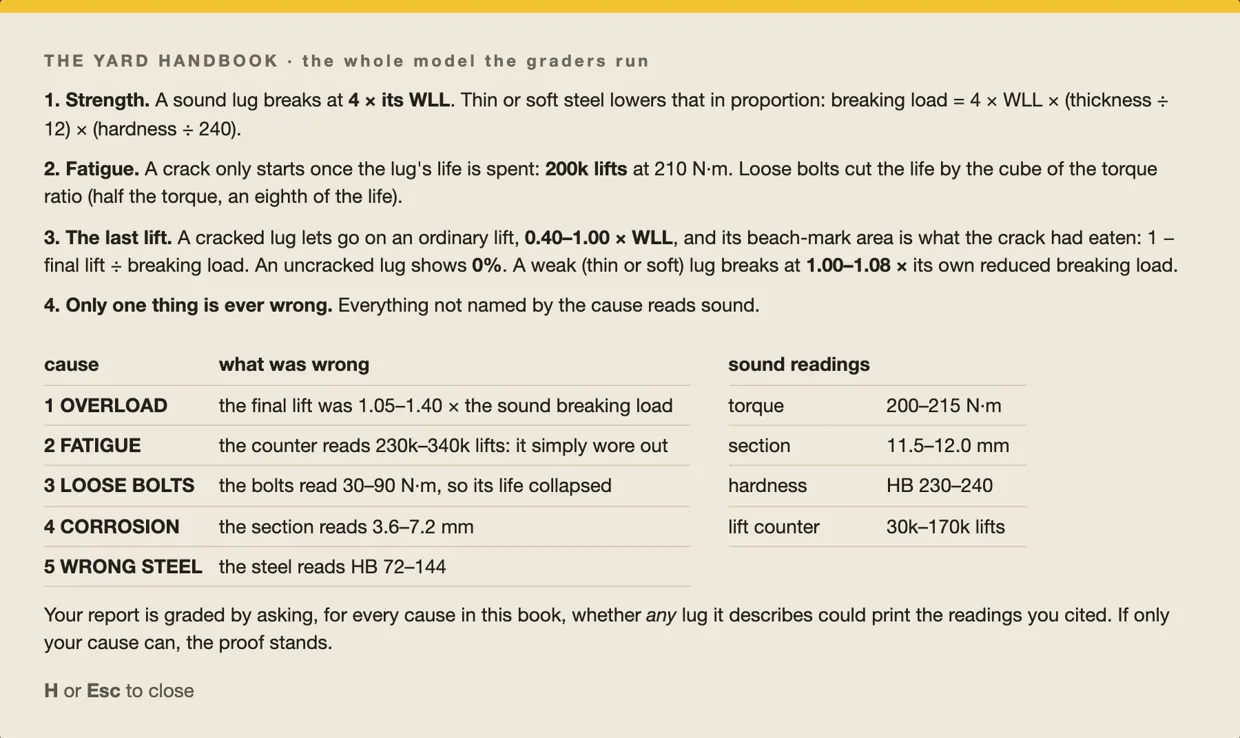
Press H in the game (or tap Handbook in the demo) and you get every rule the grader uses. There are four.
- A sound lug breaks at up to four times its rated load (the WLL, the number stamped on it). A thin or soft one breaks lower, in proportion.
- A crack only starts once the lug has used up its life: 200,000 lifts with the bolts at spec. Life scales with the cube of the bolt torque. Half the torque, an eighth of the life.
- A cracked lug lets go on an ordinary lift. The share of the section the crack already ate shows on the fracture face as rings. Those rings are beach marks. A lug with no crack shows none.
- Only one thing is ever wrong. Everything else reads sound.
Played it? Here's why the tape was enough.
On that file, a cracked lug lets go at 5 tonnes or less. A thin or soft one goes by about 13. This one was a sound lug good for about 18.7 tonnes, and the recorder caught 20.6. No other cause in the book can print that number.
Which exhibit you buy first is the puzzle
Six exhibits read the lug: the fracture face and lift counter (1 hour each), the load tape, the bolt torque and an ultrasonic thickness gauge (2 hours), and lab hardness (3). Each one rules out a different set of causes. The tape splits the five three ways. Pull the face and you split cracked from clean. Each of the other four can only ever catch its own cause.
The grader checks the proof, not the answer
The report is one cause plus whatever exhibits you cite. It's scored three ways: the cause is right, your citations rule out the other four, and you spent no more hours than par.
The proof star is the one that matters. For each of the five causes, the grader asks whether any lug that cause describes could have printed the numbers you cited. It does this exactly, with interval arithmetic over the same equations that generated the lug. No sampling, no shortcuts. If only your cause survives, the proof stands.
- A wrong cause gets nothing, and the card doesn't tell you the right one. You reopen the same lug and think harder.
- A right cause with a thin proof gets one star, and then the card shows you the cheapest proof. Nothing stops you replaying the file for three.
- Par isn't the cheapest proof in hindsight. It's the most a careful investigator who doesn't know the answer will ever need, if they pick each exhibit well.
Hearsay is free: three denials from whoever would carry the blame. The real cause is always one of the three being denied, so the two nobody mentions are out. You can't cite hearsay, and a denial can be wrong for other reasons too.
The fairness test runs 241,500 checks: 3,000 random lugs for every cause, every combination of exhibits on a sample of them, and every file across 400 seeds. It has to come back with zero failures before a change ships. I re-ran it for this page. Zero.
Each file makes the proof harder
Incident 1 is coached and generous: six hours, every exhibit on the rack. Then the game starts removing things.
- Incident 2: the lift counter was reset at the last service.
- Incident 3: the lab is shut for the weekend. No hardness test.
- Incident 4: night shift re-torqued the surviving bolts before you got there.
- Incident 5: a fresh call-out drawn from today's date. Any cause, all six exhibits, four hours. That won't buy the whole rack.
An early version let a single 1-hour exhibit settle a file on its own. So each of the middle three files takes away a different gauge, and the proof has to come from two readings that can't both be true of a sound part.
If you work around steel
You'll spot the simplifications. Real failures often have more than one cause. Safety factors vary by standard and by gear. Fatigue life scatters, and no real lug cracks at exactly 200,000 lifts.
One more you'll catch: OVERLOAD here means more than a sound lug could hold. A thin or soft lug in this game still lets go above the number stamped on it, and the game files that as corrosion or wrong steel, not two causes.
This is a clean model with one cause per lug, and the whole of it is printed on that one card. It's a puzzle, not training, and it won't teach you to call a real failure.
What I did sweat was leaks. A single reading can't give the answer away. In an early build, corrosion and wrong steel had different sound ranges, and one load reading near the top of the weak band pointed straight at corrosion. Now they share one range, and the test checks it on every build.
A couple of honest gripes
- The full game doesn't work on phones. Its title and report cards only move on the space bar. The demo on this page plays all five files by tap, so a phone can still finish it here.
- It's short. Five files, and only the fifth changes from day to day.
- The drawing of the broken lug on the desk is plain.
- Nobody outside my own test runs has played it yet. I can't tell you how long it takes or where people get stuck.
Questions
- Do I need to know engineering?
- No. The handbook is one card, and incident 1 walks you through it.
- Is it a logic grid?
- No grid. You spend hours on evidence, and picking what to pull first is the puzzle.
- How long is it?
- I don't know yet. Incident 1 is four taps if you follow the coach.
- Can I brute-force it?
- Partly. A wrong cause costs nothing: the same lug reopens with a full clock, and the card won't name the answer. Guess right and you earn one star, and then the card shows you the proof. The fun is getting the proof before the card does.
- Does it work on a phone?
- The demo here does, all five files. For the full game at /play/, bring a keyboard.
- What's a beach mark?
- The rings a growing fatigue crack leaves on a fracture face, one band for each stretch of loading. They're the classic sign of fatigue.
Four more files on the desk
Solved incident 1 above? It's saved, so the full game opens on incident 2.
Open the full game Keep playing on this page